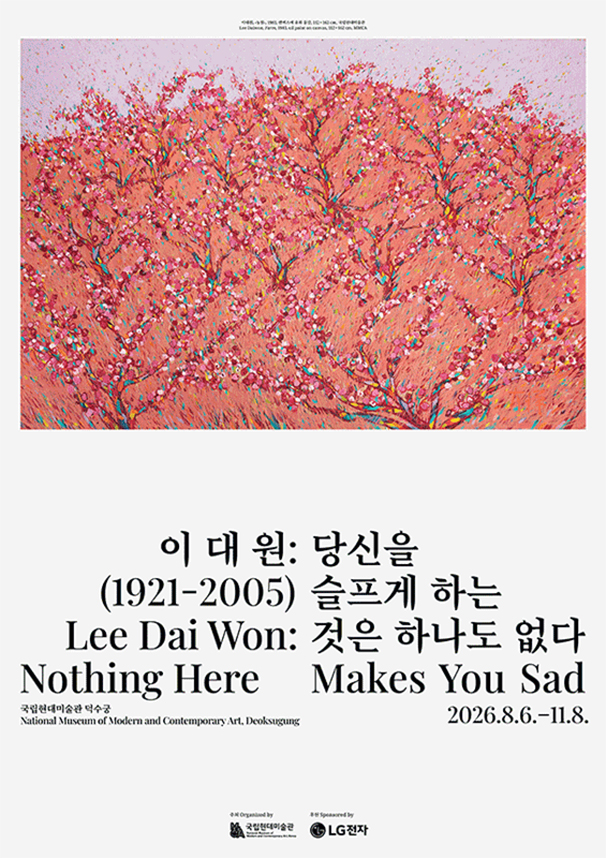
Lee Daiwon: Nothing Here Makes You Sad

Within event datesLast checked: 2026-10-02T15:56:47.938Z
Lee Daiwon: Nothing Here Makes You Sad
MMCA ·

Plan your visit

Dates
Aug 6, 2026 — Nov 8, 2026
Venue
MMCA Deoksugung 2F Gallery 1,2 / 3F Gallery 3,4
Admission
2,000 KRW(excluding Deoksugung Palace entrance fee 1,000 KRW)
Advance reservation
Not confirmed
Visit / performance duration
Not confirmed
Programme language
Not confirmed
Booking from abroad
Not confirmed

Check booking conditions with the organiser ↗An event website link does not confirm that online booking or overseas payment is available.

Confirm before you goOpening hours — Not confirmed

Provider information · 2026-10-03

South Korea · SeoulRegion highlighted · exact venue not mappedSeoulBusanJejuGyeonggiGangwonChungbukChungnamJeonbukJeonnamGyeongbukGyeongnamCURRENT KOREARegion highlighted · exact venue not mapped
South Korea

Where in Korea?

Seoul

MMCA Deoksugung 2F Gallery 1,2 / 3F Gallery 3,4

Use the venue address to check a route from your accommodation. Travel times have not been verified.

Map details

Regional overview, not a street map. Simplified 2021 boundaries; small islands omitted in the source. geoBoundaries / Natural Earth · CC BY 4.0.

About this event

Lee Daiwon (1921–2005) is one of the most widely beloved artists in modern and contemporary Korean art history.

Read the full introduction

Lee Daiwon (1921–2005) is one of the most widely beloved artists in modern and contemporary Korean art history. Depicting orchards, mountains, ponds, and fields in an array of vivid colors, his landscape paintings have long captivated the eyes and hearts of many. He became known by various epithets, such as the “happiest painter in the world” and the “fortunate painter.” But because of this familiarity, have we perhaps viewed his paintings too superficially? This exhibition refrains from considering Lee Daiwon simply as a painter of bright scenery. His radiant works were not the products of an innate optimism, but the results of decades of disciplined study, sustained experimentation, and formal refinement. His paintings do not merely replicate the colored threads of embroidery, the light of lacquerware inlaid with mother of pearl, the translucent hues of oxhorn crafts, and the dots and lines of Eastern ink wash painting. In his works, those cultural traditions are completely reborn in the form of contemporary paintings, built up layer by layer through colored lines, dots, and planes. And unlike the light of Neo-Impressionist pointillism, in which colored dots are juxtaposed to merge within our vision, the light in Lee’s paintings does not float across the surface, but is embedded and accumulated within it. Lee Daiwon used Western oil paints, but within that medium, he revitalized the aesthetic effects of Korean traditional crafts and Eastern ink wash painting, including their textures, lines, dots, and treatment of light. He did not appropriate traditional culture merely as subject matter, nor did he blindly follow Western modernism. He learned from many sources without becoming confined to any one, and he inherited the past without simply imitating it. Looking out acr

Weather for your visit

Confirm admission, opening hours and any booking requirements before you travel.

Before you go

Official exhibition list and detail dates, title and venue checked.

Event website ↗

← Back to all moments